
EP126: When "Something Broken" Isn't
Stock Ideas From Investment Professionals

Welcome, subscribers!
This week’s issue brings 7 fresh ideas from thoughtful managers across energy, industrials, tech, and financials. The common thread: businesses with real durability that are being priced like “something is broken,” whether due to a messy transition, cyclical noise, or structural changes the market hasn’t fully digested yet.
If you know someone who likes investor letters and under-the-radar setups, feel free to forward. 📬
This week, we highlight 7 new ideas, including:
Off-grid energy reset: Biggest propane distributor shifts from roll-ups to execution as route + pricing overhaul targets major margin lift.
Scarce “small ship” value: Asia-Pacific niche carrier with a young, owned fleet + net cash trades below replacement value, still spitting cash.
Installed-base durability: Pool equipment leader where most sales are repair/replace; pricing power + normalization drive upside.
AI adoption tailwind: Elite IT services firm miscast as an AI loser; enterprise rollout complexity could reignite growth.
Breakup-to-rerate setup: Streamlined industrial in Europe; divestitures + efficiency gains point to higher margins and a valuation catch-up.
Aerospace bottleneck winner: Vertically integrated aerostructures supplier levered to OEM ramp; share gains + margin expansion, with a listing catalyst.
SaaS transition mispriced: Compliance/cap-markets workflow shifting to recurring software; near-term noise masks improving margins/FCF at a cheap multiple.
Disclaimer: Nothing here constitutes professional and/or financial advice. You alone assume any risk with the use of any information contained herein. We may own positions in the securities listed. Please do your own due diligence.
To the investment managers who read this, you can send us your letters at elevatorpitches@substack.com or on Twitter (and Threads!) if you’d like to be included in a future issue.
Let’s get to it.
Emeth Value Capital pitches Superior Plus (SPB-CA), the largest propane distributor in North America, as a stable, off-grid energy business undergoing a major operational reset. A new management team is shifting focus from acquisitions to execution, creating a path to meaningful margin expansion and upside from current levels.
Overview
Superior Plus is a leading North American distributor of propane, serving 750,000 residential and commercial customers across the U.S. and Canada. The company was founded in Ontario, Canada in 1951, and today delivers approximately one billion gallons of propane annually, making the group the largest and most profitable propane distributor in North America on a per gallon basis (second largest as measured by retail gallons). In addition, Superior is the largest provider of over-the-road compressed natural gas (CNG) delivery in North America, holding a forty percent market share. Together, these assets serve a wide variety of end markets – from large-scale commercial power to residential home heat – all of which share the common characteristic that they are beyond the reach of existing natural gas distribution infrastructure. While Superior Plus has grown rapidly in recent years through more than $3 billion in acquisitions, a new leadership team has now refocused on operations to cement the advantages of this large-scale platform.
Propane Industry
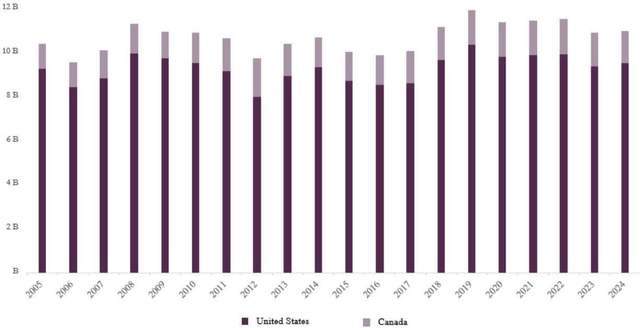
In the United States, according to data from the Energy Information Administration (EIA), approximately nine percent of U.S. households, or 11.9 million homes, use propane for at least one residential application (excluding outdoor grilling). Among these, space heating is the principal use case, with five percent, or approximately 6.1 million U.S. households, relying on propane as their primary heating source. In addition, a further two percent of U.S. households use propane as a secondary heating source, and when residential customers utilize propane for heat, they very often also use propane to power other appliances such as water heaters and cooking appliances. In aggregate, residential customers in the U.S. consume about 5.5 billion gallons of propane annually, a figure which has remained virtually unchanged for the last three decades. This stable consumption profile has resulted from an increase in the number of U.S. households using propane over time, offset in part by increasing home efficiency. Moreover, looking forward, there are several reasons why this long-term demand profile of marginal growth, or at a minimum, stability, is likely to persist. Residential propane is a rural business, often serving remote customers in low population density areas. While electricity access in the U.S. is near universal, owing to federal legislation like the Rural Electrification Act of 1936, which prioritized widespread grid access for rural America, no such programs exist for natural gas. Indeed, 39 percent of U.S. households today, or more than 51 million homes, do not have access to natural gas supply. It is incredibly expensive to expand gas distribution systems, and doing so into low density areas traditionally served by transportable fuels like propane, is economically unfeasible. For many of these households without natural gas supply who live in moderate climates in the southern U.S., electric furnaces are sufficient for the limited home heating needs they have. However, for consumers in the Northeast, Midwest, and Northwest, annual heating costs can be two to three times higher with an electric furnace versus a propane furnace, and more energy efficient air-source heat pumps, aside from the initial installation costs which can exceed twenty thousand dollars, do not work in very cold climates. In tandem, there are still four percent of U.S. households, or 4.9 million homes, that use fuel oil as their primary heat source. These customers are predominantly located in the Northeast U.S., and as these furnaces reach their natural end of life, many opt to convert to cleaner burning propane furnaces. Beyond residential use, a wide range of commercial and industrial use cases account for the remaining 4 billion gallons of the 9.5 billion gallon U.S. propane market. These include applications like commercial space heating, fuel for industrial manufacturing processes, agricultural irrigation and crop drying, and autogas for vehicle fleets. As with the residential market, commercial and industrial propane consumption has remained very stable in the U.S. over the last two decades. In Canada, the propane distribution market is an annual 1.4 billion gallons, and unlike the U.S., is significantly more weighted toward commercial and industrial customers. According to Natural Resources Canada (NRCan), approximately two percent of Canadian households, or 285 thousand homes, rely on propane as their primary heating source. While this penetration is markedly lower than that in the U.S., the residential propane market in Canada is growing rapidly. Indeed, households reporting propane as their primary heat source have tripled over the last two decades. This expansion is being driven by the decline in other traditional heating sources; twenty years ago, seven percent of Canadian households used fuel oil as their primary heat source, and another four percent used wood as their primary heat source.
Today, fuel oil and wood collectively are the primary heat source for just six percent of Canadian households, which still provides a significant base of nearly one million homes that are addressable for propane conversion. In aggregate, residential customers in Canada consume about 250 million gallons of propane annually. The remaining 1.1 billion gallons of the Canadian propane market relates to commercial and industrial users, and according to data from the Canadian Propane Association, this market has grown by about one percent per annum over the last two decades.
(Billion Gallons/Year)
Competitive Landscape
The propane distribution industry in the United States remains highly fragmented. The industry’s four majors – AmeriGas (~8%), Ferrellgas (~6%), Suburban Propane (~4%), and Superior Plus (~4%) – account for just twenty-two percent of industry volumes. Beyond the majors, the next fifty largest regional operators make up another fifteen percent of industry volumes, while more than three thousand local independent operators account for the remaining sixty percent. Although consolidation has long been a feature of propane markets, the majors have been perennial share losers to independents – effectively negating gains from acquisition activity. Of note, this dynamic has been largely self-inflicted. For example, most of the majors are structured as publicly traded master limited partnerships (MLPs), which has led to an overreliance on price increases to meet quarterly distribution targets – often at the direct expense of customer retention. In addition, the majors have uniformly suffered from organizational myopia on deal-making, resulting in neglected basic operational execution and customer service, further contributing to customer churn. While seemingly benign in any given period, the cumulative effects of this customer loss can have disastrous effects on the economics of a route-density business model (i.e., losing a customer not only impacts your revenue, but it also impacts your cost to serve of every remaining customer on that route). That said, the severity of these issues varies across the group. AmeriGas and Ferrellgas have experienced the most pronounced operational lapses and customer attrition, whereas Suburban Propane and Superior Plus have shown comparatively better performance. A case in point on these challenges at the majors being self-inflicted is the continued success of large, family-owned platforms like Thompson Gas and Blossman Gas that acquire and compete against the same group of smaller independents. Geographically, there are also significant regional differences in propane markets within the U.S. For example, in the Midwest, there is a high prevalence of agriculture co-ops that distribute propane, such as Growmark, owing to the significance of farming in this region. These co-ops operate at lower margins, as profit is a secondary motive to serving their member base, and the general abundance of propane in agriculture use creates a heightened awareness of propane wholesale pricing, compressing local residential margins. In the U.S. South-Central, aside from these markets being well suited for electric heat, there is a strong cultural bias toward customer-owned tanks. These consumers regularly price shop every new delivery, which compresses margins per gallon. In contrast, the Western U.S. benefits from fewer customer-owned tanks and, paradoxically, lower per-customer volumes, which deter cutthroat distributor competition and have resulted in attractive margins per gallon. Finally, in the Northeast, although competition is more intense, the region enjoys several structural advantages, including a sizable local base of fuel oil customers, harsh winters that limit the suitability of heat pumps, and a market where customer-owned tanks are uncommon. Geographically, Superior Plus is competitively advantaged as its footprint is heavily weighted toward the Northeast and Western U.S. markets. Indeed, sixty-five percent of Superior’s U.S. volumes are located in the Northeast, and its aggregate U.S. footprint has a company-owned tank position of ninety percent, which is significantly higher than industry averages. In Canada, the competitive landscape is quite different. Superior Plus has been the dominant propane distributor in Canada since the 1980s, and today has approximately twenty-two percent market share and is three times larger than its next competitor. In other words, in Canada, Superior’s market share is roughly the same as all four majors in the U.S. combined. The next largest distributor, Avenir Energy, holds approximately seven percent market share after acquiring the propane distribution assets of Parkland Corporation (PKI) in 2024. Beyond that, the scale of operator falls dramatically, and the remaining roughly seventy percent of the Canadian propane market is fragmented among more than three hundred local distributors. Many overarching characteristics are similar across North American propane markets. Customers in Canada overwhelmingly lease their tanks from propane companies rather than own themselves, creating sticky customer relationships, and propane markets serve largely rural off-grid customers. One notable difference is that in Canada, propane markets are heavily skewed towards large
industrial and commercial customers, and with its scale, Superior Plus excels at delivering on the needs of these demanding clients.
Superior Plus: A North American Propane Leader
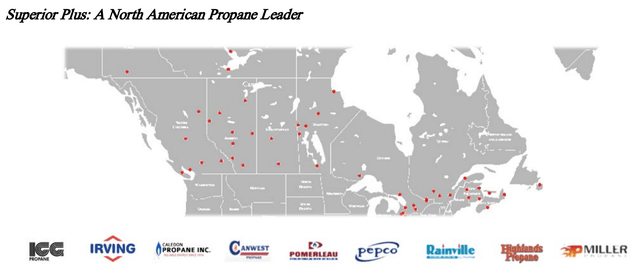
Superior Propane was founded in 1951 and today is Canada’s only nationwide propane distributor. While the business grew to become the country’s second largest propane retailer by 1980 (holding a ten percent market share), its real market dominance was solidified through two pivotal mergers. First, in 1986, Norcen Energy Resources purchased Superior Propane for $105 million to merge with its own propane distribution businesses, Cigas Propane and Monarch Propane. This positioned Superior as the largest propane distributor in Canada (approximately fifteen percent market share), leapfrogging Inter-City Gas Corporation (ICG). Then, in 1998, Superior Plus announced the transformative acquisition of ICG Propane for $126 million, which brought together the two largest propane distributors in Canada. On a combined basis, the new Superior Plus had approximately thirty percent market share of propane distribution in Canada, delivering an annual 375 million gallons. Indeed, this dominant market position prompted litigation from Canada’s competition authority, which prevented the two businesses from actually merging until 2000. It is worth noting that by this time, Norcen had decided to separate Superior Propane into a stand alone entity by forming the Superior Plus Income Fund – a Canadian equivalent to an MLP – which was listed on the Toronto Stock Exchange. Unfortunately, much like this structure has proven ill-suited for U.S. propane counterparts, this organizational reorientation around a yield led to an expensive and misguided detour for Superior Plus. For the first half century of its existence, Superior operated as a pure play energy distribution business. However, in 2002, the company embarked on a journey to significantly diversify its operations with the aim of producing more stable cash flows. Over the next five years, Superior Plus spent $1.1 billion acquiring: (i) a specialty chemicals business that produced sodium chlorate, chlor-alkali, and sodium chlorite [chemicals used in the bleaching of wood pulp for paper products], (ii) a construction products distribution business, and (iii) an aluminum manufacturer. While initially celebrated by capital markets, these acquisitions on the whole proved to be value destructive, and incredibly distracting for the base propane business. Ultimately, Superior Plus exited the aluminum business in 2006 (after only a year of ownership), exited the construction products division in 2016, and exited the specialty chemicals business in 2021. Nonetheless, by 2016, Superior’s annual propane volumes in Canada had dropped to approximately 225 million gallons, and they had ceded more than ten percentage points of market share. Another notable more recent acquisition includes Superior Plus’s purchase of Canwest, the propane distribution business of Gibson Energy (GEI) in 2017 for $296 million. This business served oil and gas end markets, a sector bet that ultimately proved to be a flop, but increased the combined group’s footprint to 300 million annual gallons (approximately twenty-five percent market share). Today, Superior Plus once again operates as a pure play energy distribution business, serving nearly two hundred thousand residential and commercial customers across Canada – delivering approximately 270 million gallons annually. In addition, the group’s existing customer base in Canada is high quality with ninety-five percent company owned tanks, a benchmark that is unmatched by any major propane distributor globally. In total, twenty percent of the company’s profits, or $90 million in annual EBITDA, is generated by the Canadian propane business.
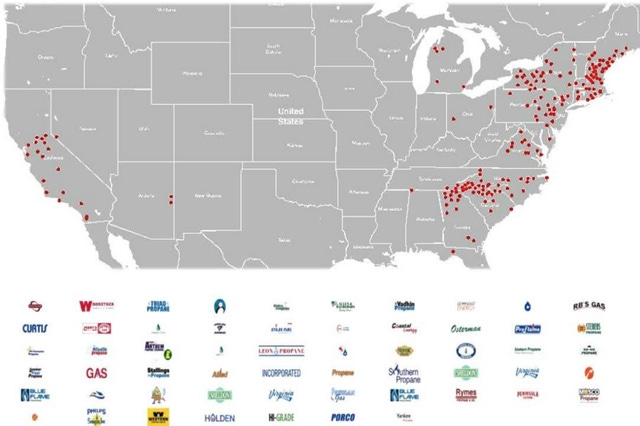
While Superior Plus has been a dominant propane distributor in Canada since the 1980s, its U.S. operations are relatively nascent. The company entered the U.S. market in 2009 with the purchase of energy distribution assets from Sonoco and Griffith Energy. These assets were geographically located in attractive Northeast markets, but were heavily weighted toward fuel oil volumes. For consumers, fuel oil is both a more expensive and emissions intensive form of heat. And for distributors, fuel oil carries lower margins and the average customer churns three times as much as in the propane industry – principally because there are no company-owned tanks in the fuel oil industry. In the near decade that followed, little changed; Superior’s U.S. operations remained subscale and nearly ninety percent fuel oil by volumes. However, in 2018, Superior Plus announced the acquisition of NGL Energy (NGL)’s retail propane assets for $900 million, quadrupling the size of the U.S. propane business overnight. Additionally, in the subsequent five years, Superior Plus acquired more than forty U.S. propane companies, spending a further $1.1 billion. Overall, these companies were widely regarded in the industry as high-quality assets and located in attractive markets. Reflecting that, Superior Plus generally paid a premium, with pre-synergy acquisition multiples averaging about 9x EV/EBITDA compared to an industry benchmark closer to 7x EV/EBITDA. As a result, today sixty-five percent of Superior’s volumes in the U.S. are located in the Northeast, where tailwinds from fuel oil switching are significant, and the group has almost no exposure to agricultural heavy midwestern states where margins are slim. Moreover, Superior has a company-owned tank position in the U.S. of eighty-nine percent, which is significantly higher than industry averages. In total, Superior’s U.S. operations deliver approximately 350 million gallons of propane annually to more than five hundred thousand residential and commercial customers. In addition, fifty percent of Superior Plus’s profits, or $240 million in annual EBITDA, is generated by the U.S. propane business.
Superior Delivers: Building A Modern Propane Company
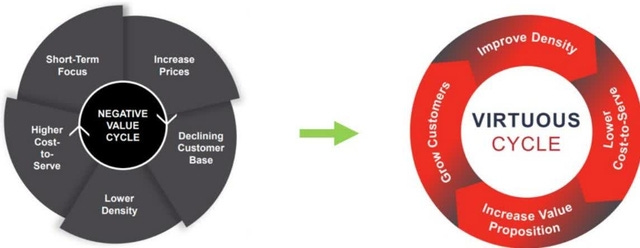
As noted previously, the quality of service and operational execution at Superior Plus was not immune to its torrid pace of dealmaking over the prior decade. Fortunately, the planned retirement of the company’s longtime CEO in 2023 created an opportunity for a new leadership team, under CEO Allan MacDonald, to approach the business with a fresh perspective. This culminated in the announcement of the “Superior Delivers” transformation program in November 2024, an overhaul that would touch virtually all operating aspects of the business and targeted a $70 million increase in EBITDA by 2027. These initiatives were broadly organized into two inter-related categories: (i) cost to serve, and (ii) customer growth. While the action items of the transformation program are distinct, they are also mutually reinforcing in that they work together to move Superior Plus away from its legacy negative value cycle (i.e., price increases → customer churn → lower density → higher cost to serve → price increases) to a positive value cycle (i.e., lower cost to serve → better pricing → customer acquisition → higher density → lower cost to serve).
For an operations focused leadership team generally coming from much larger companies in non-propane industries, the lack of sophistication and proverbial low-hanging fruit within Superior’s operations was striking. Processes were antiquated, inconsistent, highly manual, and the dozens of acquisitions made in years prior had never been integrated. At the core, what is enabling this cost to serve transformation is a wholly new analytics platform that handles real-time pricing underpinned by customer specific marginal cost calculations, dynamic route optimization and delivery scheduling, and asset utilization management. To bring this to life with some examples, consider that when the new leadership team arrived, Superior Plus did not have the ability to calculate the cost to serve at the customer level. The company was using local averages. The problem with that is that in a route-based business model, even within a thirty mile radius, if there are four customers on Street A and only one customer on Street B, which is forty miles away, the cost of delivering to those customers is dramatically different. What they found was that they were losing money on every delivery to approximately five percent of the customer base, because these customers had been priced to local averages when their customer specific delivery cost in reality was much higher. Eliminating these customers, or retaining them at much higher pricing, was a clear win. Another pillar of lowering cost to serve is asset utilization, and after more than forty acquisitions in a five year stretch, not to mention the dozens of companies NGL Energy itself had acquired prior to Superior’s ownership, the group’s asset base had become plainly overbuilt. However, Superior Plus did not have the technical capability to determine what the optimal infrastructure footprint should look like. This required mapping the unit costs of every bulk plant location and bringing that data into a tool that could dynamically recalculate the cost to serve for every customer, based on their exact location, for every permutation of network configuration. In other words, not something you could do in an excel spreadsheet. The output: Superior Plus was able to optimize its network to eliminate more than a third of its bulk plants in many regions. While this increased the on-the-road costs by as much as twenty percent, as the total miles traveled would increase, the all in cost to serve is expected to decline by double digits. Next, perhaps the central component of Superior’s cost to serve transformation is overhauling its routing and scheduling technology. There are a few key variables this tool is seeking to optimize. For example, tank percentage filled per delivery – ideally you want to drop as many gallons on a single stop as possible. If you stop on a route and only fill ten percent of a customer’s tank, that is very inefficient. Another metric would be miles driven per gallon – ideally you drive as few miles as possible to deliver as many gallons as possible. This means accurately forecasting and batching orders in the same locality, and creating the most efficient routes possible for any given combination of stops. In addition, labor hour per gallon is another important metric. This means maximizing the in-field labor costs by delivering to the right stops in a given day, not simply the stops that happen to be along a route. With over 750,000 customer locations and more than 2.1 million deliveries per year, optimizing this process becomes complicated very quickly. And yet, the group’s legacy process involved scheduling deliveries from the local office a day or two in advance on an ad-hoc basis. Consider the following. Superior Plus is among the most advanced deployers of tank monitoring sensors in the propane industry. The group has sensors deployed that cover approximately seventy-five percent of deliveries. This compares to the average industry operator at around fifteen percent penetration. However, the way that Superior had historically leveraged this technology is that its internal system would automatically schedule a customer for delivery within three days if their tank fell below thirty percent. The problem with that is that thirty percent could very well be three days of supply, but it also could be three weeks of supply, or in some cases three months of supply. By having a rigid auto-scheduling rule that did not factor in the rate of consumption, Superior would often find itself delivering to the same neighborhood twice in one week when those deliveries should have been more efficiently batched. The new delivery system at Superior Plus works off of a days-to-empty metric, which factors in real-time consumption, and looks weeks in advance, not a day or two, to build the most efficient scheduling of deliveries. Finally, Superior’s new routing tool leverages artificial intelligence to design optimized driving routes that aren’t obvious without this technology. In one example, by moving a customer from one driver’s route to a neighboring route, Superior was able to lower the cost to serve of a specific customer by fifty percent, and lower the average cost across both routes by about ten percent. In aggregate, the cost to serve transformation is expected to deliver $40 million of incremental EBITDA annually.
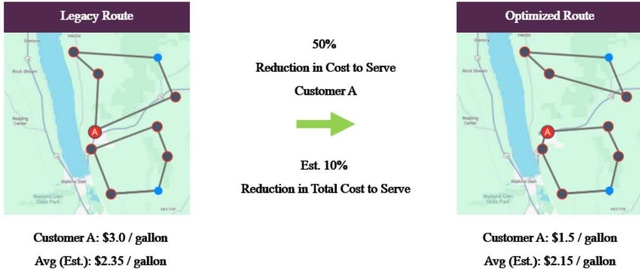
The second pillar of transformation is customer growth. The purpose of transforming Superior’s cost to serve is really two-fold; Of course, to maximize profits within the existing customer base, but also to then leverage that cost advantage into acquiring new customers. Importantly, this advantage will not be uniform across the company’s network. Recall that Superior Plus historically did not have the ability to calculate customer specific delivery costs. With this new tool, Superior can now lean in the hardest on customer acquisition in areas where it knows its cost to serve is the most advantaged. This allows the company to both offer the best price while also making healthy margins. For example, using the illustration above, suppose hypothetically that Customer A was a new customer. Superior’s pricing platform would show that the marginal cost to serve this new customer, given the company’s existing footprint, is only $0.10 per gallon. Superior charges $3.00 per gallon on average for propane in the U.S., which gives them ample flexibility to profitably acquire that customer even while offering a great price. Historically, Superior Plus had a total of seven employees in its marketing department, and the near sole source of customer additions was through answering inbound phone calls. Now, under the leadership of a new Chief Commercial Officer, Deena LaMarque Piquion, the former Chief Marketing Officer at Xerox, Superior for the first time will have the ability to target specific customer groups with a data-backed pricing approach, and nearly every channel of customer lead generation will be net new. The second vector for improving customer growth is reducing gross churn. During the course of the last five to seven years when acquisitions took precedence over operations, Superior Plus operated with mid-to-high single digit gross churn. This compares to an industry benchmark of low-to-mid single digit gross churn for high quality regional propane operators. On a net basis, natural inbound customer additions reduced Superior’s churn to low a single digit percentage, which the company then bridged the gap with pricing increases – setting into motion the negative flywheel. At the outset, price increases categorically raise churn, and so Superior has stopped all price increases over the last eighteen months. Within propane markets, customer churn lags the root cause by about six to eighteen months – i.e., if a customer is upset by a price increase, they would only look to switch providers when their tank is nearing empty again – so the benefits of Superior’s price freezes are now beginning to bear fruit. To add to that, Superior Plus now has a centralized team that is in charge of customer retention and can proactively address churn. The company’s new analytics platform ingests customer specific data like account login activity, changes in usage patterns, or identified service issues and forecasts the customers that are most at risk to churn. Superior can then reach out to these customers, and with the new pricing models can now be more aggressive on the offer they can provide to retain those customers. In total, the customer growth transformation is expected to deliver an incremental $30 million in EBITDA annually by 2027, or approximately two percent per annum expected net customer growth.
Wholesale Propane
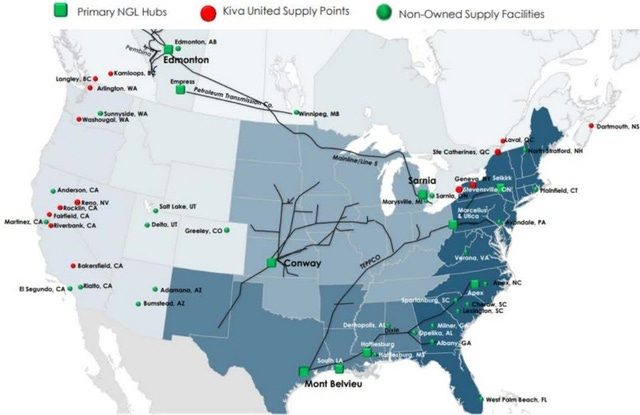
An asset unique to Superior Plus among the propane majors is a significant wholesale propane business. This segment operates under Superior Gas Liquids in Canada and Kiva United Energy in the U.S., and handles logistics and supply management for over one billion gallons of propane annually. Two-thirds of this volume relates to supplying the entirety of Superior’s own retail operations across North America. This reduces costs by removing intermediaries from the procurement process, ensures surety of supply in peak demand environments, and creates opportunities to lower costs by arbitraging supply markets. In addition, the division’s more than thirty million gallons of storage assets and commodity hedging expertise allow Superior Plus to offer its retail customers fixed-price contracts. The remaining third of wholesale volumes relates to third-party sales to more than three hundred customers. These clients include other retail propane distributors and large-scale industrial users. These third-party sales increase the utilization of Superior’s supply infrastructure and generate margin that even further lowers the overall company cost to serve. Notably, Kiva United Energy has historically focused only on serving third-party clients in the Western U.S. However, as the group assumed supply responsibilities for the entire Superior Plus U.S. retail operations in 2025, this now presents new opportunities for the group to grow its third-party client list in new markets like the Northeast. In total, Superior’s wholesale propane operations generate $35 million in annual EBITDA.
Certarus: North America’s Leading CNG Platform
In 2022, Superior Plus acquired Certarus for $785 million. Certarus is the market leader in over-the-road compressed natural gas (CNG) delivery, serving pipeline-stranded customers that previously relied on more expensive and carbon intensive fuels such as diesel or other distillates. Since its founding in 2012, Certarus has scaled rapidly and now delivers more than 30 Bcf of CNG annually across its fleet of 870 mobile storage units (MSUs). In the early 2010s, oil and gas operators began introducing dual-fuel drilling and hydraulic fracturing equipment capable of displacing approximately thirty percent of diesel consumption with natural gas. Advances in engine controls and emissions technology have since allowed modern Tier 4 dual-fuel engines to achieve significantly higher substitution rates, in some cases approaching eighty percent. This has generated substantial cost savings as natural gas, even after factoring in compression and logistics costs, is sixty to seventy percent cheaper than diesel. Certarus was founded to serve this burgeoning market by providing an end-to-end CNG supply solution for oil and gas wellsites, which are naturally beyond the grid customers. Today, this remains an important part of Certarus’ business, accounting for approximately half of revenues, and the group maintains a dominant fifty percent market share of CNG deliveries in key U.S. basins like the Permian. However, over the last five years, Certarus has also had success in diversifying its business beyond the wellsite. For example, in the Northeast, longstanding regulatory barriers to developing new midstream infrastructure, coupled with the increasing demand for electricity generation, have led to a regional pipeline network with a high risk of curtailments during peak winter months. To address this, Certarus provides utility clients with dedicated MSUs on lease, ready to inject natural gas directly into local infrastructure to avoid a loss of pressure (i.e., blackouts). This utility resiliency market today stands at approximately 33 Bcf annually, which is expected to double by 2030. In addition, Certarus’ fleet is capable of transporting other alternative fuels like Hydrogen and renewable natural gas (RNG). RNG projects capture and process methane emitted from landfills, pig and dairy farms, and waste water treatment plants. The number of operational RNG facilities in the U.S. has increased tenfold over the last decade; however, many potential RNG projects remain in isolated areas with no access to a pipeline distribution network. Certarus is already the North American leader in transporting stranded RNG to market, with an estimated fifty percent market share, offering developers turnkey solutions that incorporate critical services such as chain-of-custody tracking. This segment is growing rapidly, and according to a 2025 study commissioned by the American Gas Foundation, domestic RNG production in the U.S. is expected to increase by a further sevenfold over the coming decade. Indeed, Certarus’ own RNG business is currently growing at forty percent per annum, and it expects the over-the-road RNG market can reach a market size of 25 Bcf annually by 2030. More recently, Certarus is benefiting from the immense hyperscale data center buildout occurring to support AI. Power demand from this AI infrastructure buildout is expected to drive a fivefold increase in total data center power requirements over the coming decade, amid an environment where grid connection times are already in excess of five years in many markets. Certarus can provide data center customers both short-term and long-term bridge solutions while they wait for permanent grid or pipeline connectivity. For example, in September Certarus was awarded a supply agreement to support a 50MW hyperscale data center between site commissioning and its planned transition to a permanent pipeline connection. In addition, in October Certarus was awarded a project to provide standby power for a second hyperscale data center. While it is difficult to assess the exact scale of opportunity AI infrastructure will provide for over-the-road CNG, the potential is significant as powering a single hyperscale facility can require dozens of MSUs. Finally, Certarus is also growing its offerings for non-wellsite commercial and industrial customers across a broad range of use cases including: fuel for industrial manufacturing processes, power and heat for remote communities, disaster relief, pipeline bypass for planned infrastructure maintenance, and industrial-scale backup power. The industrial segment of Certarus’ business is currently growing more than twenty percent per annum. In total, thirty percent of Superior Plus’ profits are generated by Certarus, or $140 million in annual EBITDA.
Valuation
In 2020, Brookfield Asset Management (BAM) made a $260 million investment in Superior Plus in the form of perpetual preferred securities that carry a 7.25 percent coupon, and have the right to convert into thirty million common shares at a price of $8.67 per share (approx. C$11.89). Of note, this investment was made out of Brookfield’s private equity funds, which have target returns in excess of twenty percent per annum. Brookfield’s optimism was not without precedent. In Europe, companies like SHV Energy and DCC Plc have rolled-up hundreds of local and regional LPG distributors since the 1980s, consolidating the market and generating highly attractive returns. Indeed, since its listing in 1994 until Brookfield’s investment in Superior Plus in 2020, DCC Plc generated a seventeen percent annum return for shareholders – or a 46x. Meanwhile, in the US market, consolidation remained far behind that in Europe and an opportunistic window existed where all the propane majors were on the sidelines from acquisitions for their own reasons. Ferrellgas was still reeling from their $837 million purchase of Bridger Logistics, a crude oil trucking business that was written down by eighty percent fifteen months after acquisition, while AmeriGas and Suburban Propane were struggling with debt loads from the large scale acquisitions of Heritage Propane ($2.9 billion) and Energy Propane ($1.8 billion), respectively. While the journey was not without challenges, namely the subsequent operational missteps discussed previously, Superior Plus was largely successful in its aim to acquire several high quality and attractively priced propane distribution assets. Today, with a renewed focus on operations, we own this much larger collective platform at C$7.04 per share, or more than a forty percent discount to Brookfield’s investment. Consider the base case scenario modeled below.
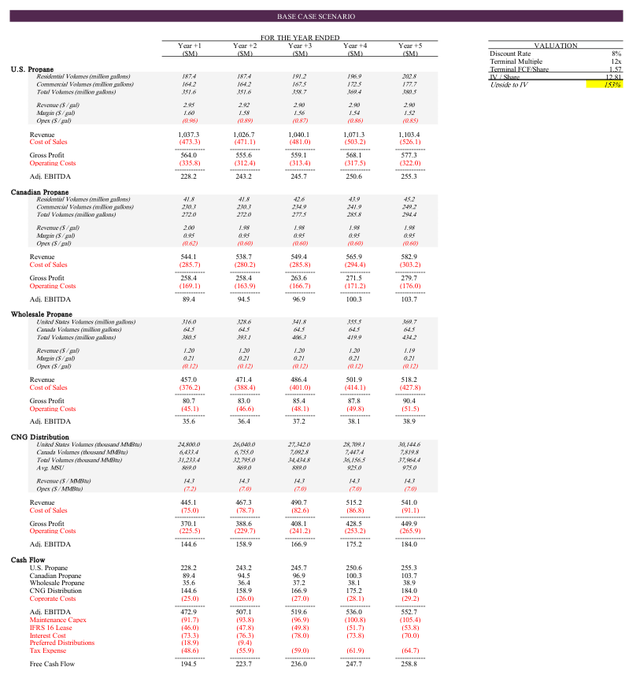
The assumptions embedded above, though forecasting attractive shareholder outcomes, are significantly more conservative than management estimates. To start, this scenario assumes that by 2027 management only delivers on the cost to serve portion of the Superior Delivers transformation – or $45 million of the total $75 million in expected incremental EBITDA. Moreover, in keeping with the company’s stated strategy of increasing customer density, customer churn in the U.S. is expected to occur at an average margin per gallon of $1.90, significantly above the segment average, while newly acquired customers are expected to have average unit margins of $1.50 per gallon. While hinted at previously, it is worth expanding upon the unique pricing dynamics within the propane distribution industry, and why these margin assumptions are indeed quite conservative. For both residential and commercial customers alike, Superior Plus owns the physical tanks located at the customer’s property in ninety percent of cases. Container laws - which exist in every state apart from West Virginia, Wyoming, Alaska, and Hawaii – make it illegal for another propane company to fill these Superior-owned tanks. In the most extreme of cases, these are 1,500 gallon tanks buried underground, where the cost of excavating and replacing can run into the tens of thousands of dollars. For above ground tanks, while customer churn does occur, there are several factors which in practice deter customers from switching. For example, while competitors will often install a leased tank at a new customer property for “free”, there are exit fees owed to the incumbent propane distributor in the form of tank removal fees, fuel pump-out fees, and contract termination fees. These in aggregate can regularly add up to $500 to $800 in exit costs. For a residential customer consuming an average of 700 gallons of propane per year, even if you feel you are being overcharged by 25c or 40c per gallon, it likely does not make sense to switch. Said another way, margins per gallon could be twenty to thirty percent higher than competitors before it pushes a customer to switch. In addition, in reality it is far from free for a competing propane distributor to set a new tank. A standard 500 gallon tank installation takes two technicians three to four hours to complete, with a needed LP crane truck. In labor costs alone this is several hundred dollars, and the replacement cost of a new 500 gallon propane tank today is several thousand dollars. As a result, to recover costs, most propane distributors require a three-year service contract with a leased tank, and often disqualify low-usage customers who only use propane for cooking or hot water heating. Thus, customers switching, assuming they meet the minimum usage requirements, have the added decision of weighing if they want to lock themselves into a three year contract with a provider they have never used before. Also consider that at the time customers are most likely to contemplate a provider switch, during peak heating season when eighty percent of deliveries occur, most propane companies either cannot or will not set a new tank due to being overwhelmed with existing deliveries. Finally, the biggest deterrent to churn is simply customer inertia. For customers with leased tanks, Superior Plus has customers on auto-delivery, where the tanks are remotely monitored and the scheduling of refills and payments occurs automatically. Most customers simply do not want to have to think about their propane supply, which is why the most common cause of switching providers is a service issue, not cost. Now let’s turn to how customers are priced. For large commercial accounts, it is common for these high usage customers to have index-plus pricing where a fixed margin will be added to spot pricing quoted at Mont Belvieu or Conway. For residential customers, contracts operate on stated price basis. Translation – customers are charged a price at the complete discretion of the propane supplier, which in theory incorporates variables such as transportation costs, usage, and spot pricing, but in reality reflects the margins the distributor would like to earn. This pricing discretion combined with the aforementioned customer stickiness, is what has underpinned consistent margin per unit increases across the propane industry for many years. Consider the graphic below.
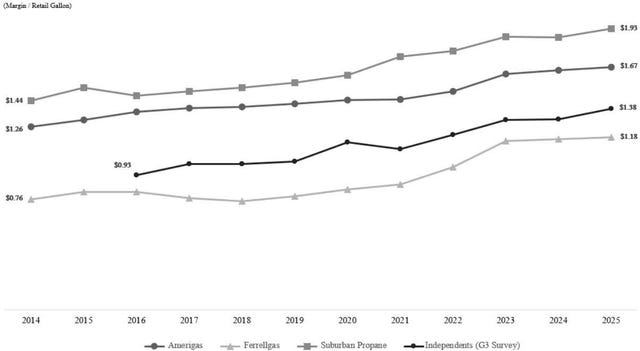
While Superior Plus’s unit margins are higher than independents, on an adjusted basis, they are already significantly below their national peers. For example, AmeriGas unit margins are similar on headline figures at $1.67 per gallon, but it has half the exposure to high margin residential gallons as Superior Plus, a thirty percent weighting to low margin autogas volumes, and a twenty percent weighting to the Midwest which has half the margins as other regions. Adjusting for these exposures, I believe AmeriGas has margins closer to $1.95 per gallon on a comparable basis. Similarly, while Suburban Propane has headline unit margins that are already higher than Superior Plus, they also have ten percentage points less exposure to residential gallons and an eighteen percent exposure to the Midwest. These adjustments would put their comparable unit margin at approximately $2.07 per gallon. Ferrellgas is more challenging to compare as it has a significant majority of its business in the Midwest, sells thirty percent of its volumes each year to customers who own their own tanks, and also has half the residential volumes as Superior Plus. Still, adjusted for these factors I estimate Ferrellgas’ comparable unit margins are $1.85 per gallon. All of this to say, I believe the unit margin targets implied in the base case scenario above are highly achievable. For the customer growth portion of the Superior Delivers transformation, this scenario assumes a low single digit net customer churn in 2026, stabilization in 2027, and returning to low single digit organic customer growth in 2028. This compares to management estimates of cumulative net customer growth of seven percent between 2025 and 2027, and returning to organic customer growth already by late 2025. Altogether, this implies that EBITDA for Superior Plus comes in at approximately $510 million in 2027, or approximately eleven percent below the $570 million target. Finally, consider that while Allan MacDonald and the new leadership team have refocused on operations, they have also made wholesale changes to capital allocation. In November 2024, Superior Plus cut its dividend by seventy-five percent, and redirected the entirety of those proceeds to buying back its own stock. From November 2024 through December 2025, Superior Plus has repurchased 29.8 million common shares at an average price of C$6.81, or approximately twelve percent of the outstanding shares in a one year period. In addition, looking forward, Superior plans to buyback a further $100 million (C$135 million) per year in 2026 and 2027. The base case scenario modeled above assumes that the company completes these repurchases at an average price of C$9.0 in 2026 and C$11.0 in 2027; significantly higher than prevailing share prices, and implying a compounding rate of over twenty-percent per annum. Furthermore, recall the Brookfield perpetual preferreds. In July 2027, these preferreds become callable by Superior Plus at par, which would generate $9 million in cash savings per annum if refinanced with the company’s existing revolver capacity, while also avoiding dilution. This scenario assumes that those preferreds are called at par (note: while dilution is possible, that would also mean that shares are trading above C$11.89 by July 2027, and we made at least a 1.7x MoC in eighteen months or less). Taken together, the output of the model above implies a fair value of C$17.79 (US$12.81) per share, or 153 percent upside to intrinsic value. Framed another way, over the course of five years, Superior Plus is expected to generate more than its current market capitalization in free cash flow.
M&A
At present, Superior Plus is fully focused on setting the business back on proper operational footing. However, in the long term, this business should have clear platform value as a consolidator in this highly fragmented space. There are more than three thousand independent propane distributors in the U.S., and the industrial logic for consolidation is evident. Small and midsize distributors lack the scheduling and routing technology, pricing sophistication, and digital offerings that Superior Plus can bring to the table. Moreover, synergies can often reduce the purchase price by two turns or more, and are achieved through predictable cost outs. For example, eliminating redundant administrative and management positions, consolidating bulk plant locations, and procurement savings. In extreme scenarios, for small propane distributors with a high overlap to Superior’s existing customer network, a significant portion of the on-the-road costs could also be eliminated if newly acquired customers could be serviced with the existing fleet. There are approximately 1,100 acquisition targets within Superior Plus’s delivery footprint, and I estimate that about half of those distributors deliver two million gallons or more annually. If Superior Plus is able to complete five to ten of these tuck-in acquisitions per year at a 7x multiple, they could add an additional $50 million of EBITDA over a five year period with $250 million of total capex. This would be significantly more accretive to shareholders versus paying down low cost debt, and would achieve nearly the same deleveraging outcomes. In addition, if done correctly, these acquisitions should serve to even further accelerate Superior’s flywheel of creating more density, lowering cost to serve, and offering the best price.
Weather
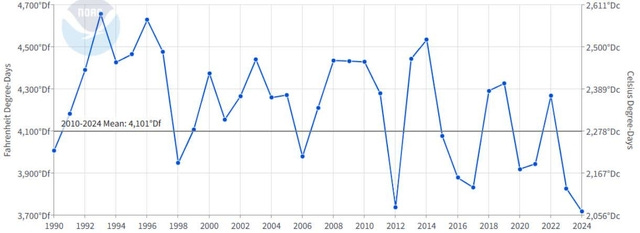
A final point to make about the propane industry broadly is that it is of course a weather dependent business. While year to year changes come out in the wash in the long run, how cold a winter season is in any given year can have a significant impact on demand. With that in mind, Superior Plus’s prior acquisition spending on the surface looks more value-destructive than reality because 2024 was one of the warmest years on record over the last thirty years (i.e., ~10% warmer than normal on a heating degree day basis). While it is impossible to know what any future year will bring, it is a helpful baseline to know that in this outlier warm year, and before the impact of the Superior Delivers operational improvements, Superior Plus generated $455 million of EBITDA in 2024.
Contiguous U.S. Heating Degree Days
January-December
Six more stock pitches below, available to paid subscribers.
If you find value in seeing how professional investors frame new ideas, upgrade to keep reading and get the full archive.
Need a nudge? Many subscribers work in asset management, research, or corporate finance and expense it as a research tool. Here’s a quick script you can use.
Hi [Manager’s Name],
I’d like to expense a subscription to Elevator Pitches, a newsletter that curates stock ideas from professional investor letters, often highlighting overlooked opportunities and special situations.
With a paid subscription, I’d receive full access to every stock write-up they publish each week, which would support my ongoing market research and idea generation.
The cost is $90 for the full year. Given the depth and frequency of the analysis, I think it’s a cost-effective addition to my research toolkit.
Please let me know if this works.
Best,
[Your Name]